what was leeuwenhoeks contribution to the science of microbiology
| Antonie van Leeuwenhoek | |
|---|---|
 A portrait of Antonie van Leeuwenhoek (1632–1723) by Jan Verkolje | |
| Built-in | (1632-x-24)24 October 1632 Delft, Dutch Republic |
| Died | 26 August 1723(1723-08-26) (anile 90) Delft, Dutch Republic |
| Nationality | Dutch |
| Known for | The outset acknowledged microscopist and microbiologist in history[note one] Microscopic discovery of microorganisms (animalcule) |
| Scientific career | |
| Fields | Microscopy Microbiology |
| Influences | Robert Hooke Regnier de Graaf |
| Influenced | History of biological science and life sciences Natural history Scientific Revolution Historic period of Reason |
| Signature | |
 | |
Antonie Philips van Leeuwenhoek [note two] FRS ( AHN-tə-nee vahn LAY-vən-hook, -huuk; Dutch: [ɑnˈtoːni vɑn ˈleːuə(n)ˌɦuk] (  mind );[v] 24 Oct 1632 – 26 Baronial 1723) was a Dutch businessman and scientist in the Aureate Age of Dutch scientific discipline and technology. A largely cocky-taught human in scientific discipline, he is normally known every bit "the Begetter of Microbiology", and one of the first microscopists and microbiologists.[6] [7] Van Leeuwenhoek is best known for his pioneering piece of work in microscopy and for his contributions toward the establishment of microbiology every bit a scientific discipline.
Raised in Delft, Dutch Democracy, van Leeuwenhoek worked as a draper in his youth and founded his own shop in 1654. He became well recognized in municipal politics and developed an interest in lensmaking. In the 1670s, he started to explore microbial life with his microscope. This was ane of the notable achievements of the Golden Age of Dutch exploration and discovery (c. 1590s–1720s).
Using single-lensed microscopes of his own design and make, van Leeuwenhoek was the outset to observe and to experiment with microbes, which he originally referred to as dierkens, diertgens or diertjes (Dutch for "small animals" [translated into English as animalcules, from Latin animalculum = "tiny animal"]).[8] He was the kickoff to relatively decide their size. Most of the "animalcules" are now referred to as unicellular organisms, although he observed multicellular organisms in swimming h2o. He was also the first to document microscopic observations of muscle fibers, leaner, spermatozoa, cherry claret cells, crystals in gouty tophi, and among the first to see blood flow in capillaries. Although van Leeuwenhoek did not write any books, he described his discoveries in letters to the Royal Order, which published many of his messages, and to persons in several European countries.
Early life and career
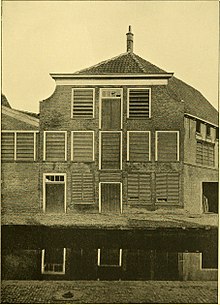
Van Leeuwenhoek's nativity house in Delft, in the Netherlands, in 1926 before it was demolished
Antonie van Leeuwenhoek was built-in in Delft, Dutch Democracy, on 24 October 1632. On 4 November, he was baptized as Thonis. His father, Philips Antonisz van Leeuwenhoek, was a handbasket maker who died when Antonie was only five years old. His mother, Margaretha (Bel van den Berch), came from a well-to-practise brewer's family. She remarried Jacob Jansz Molijn, a painter. Antonie had iv older sisters: Margriet, Geertruyt, Neeltje, and Catharina.[9] When he was around ten years old his footstep-father died. He attended schoolhouse in Warmond for a brusk time before beingness sent to live in Benthuizen with his uncle, an attorney. At the age of 16 he became a bookkeeper'south amateur at a linen-draper's shop in Amsterdam,[10] which was owned by the Scot William Davidson. Van Leeuwenhoek left in that location afterwards six years.[xi] [12]
Van Leeuwenhoek married Barbara de Mey in July 1654, with whom he fathered i surviving girl, Maria (iv other children died in infancy). That same yr he returned to Delft, where he would live and report for the balance of his life. He opened a draper'due south shop, which he ran throughout the 1650s. His wife died in 1666, and in 1671, van Leeuwenhoek remarried to Cornelia Swalmius with whom he had no children.[13] His status in Delft had grown throughout the years. In 1660 he received a lucrative task as chamberlain for the assembly chamber of the Delft sheriffs in the city hall, a position which he would hold for nigh 40 years. In 1669 he was appointed as a state surveyor by the courtroom of Holland; at some time he combined it with another municipal job, being the official "wine-gauger" of Delft and in charge of the city wine imports and taxation.[14]
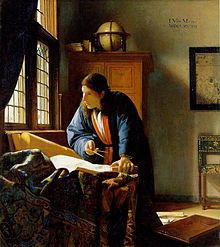
Van Leeuwenhoek was a gimmicky of some other famous Delft citizen, the painter Johannes Vermeer, who was baptized only iv days before. It has been suggested that he is the human being portrayed in 2 Vermeer paintings of the tardily 1660s, The Astronomer and The Geographer, but others argue that there appears to be footling physical similarity. Because they were both relatively important men in a urban center with only 24,000 inhabitants, information technology is possible that they were at least acquaintances; van Leeuwenhoek acted as the executor of Vermeer's will subsequently the painter died in 1675.[xv] [note three]
Microscopic study
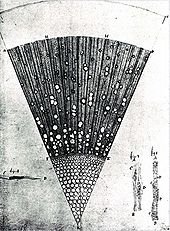
A microscopic section of a ane-year-old ash tree (Fraxinus) wood, drawing fabricated by van Leeuwenhoek
While running his draper shop, van Leeuwenhoek wanted to come across the quality of the thread better than what was possible using the magnifying lenses of the fourth dimension. He developed an involvement in lensmaking, although few records exist of his early on activity. By placing the centre of a minor rod of soda lime glass in a hot flame, one can pull the hot section apart to create two long whiskers of drinking glass. Then, by reinserting the finish of i whisker into the flame, a very pocket-size, high-quality glass lens is created. Significantly, a May 2021 neutron tomography report of a high-magnification Leeuwenhoek microscope[16] captured images of the short glass stem characteristic of this lens creation method. For lower magnifications he too made ground lenses.[17] To help keep his methods confidential he plain intentionally encouraged others to call up grinding was his primary or merely lens construction method.
Recognition by the Imperial Society
After developing his method for creating powerful lenses and applying them to the study of the microscopic globe,[18] van Leeuwenhoek introduced his work to his friend, the prominent Dutch physician Reinier de Graaf. When the Purple Lodge in London published the groundbreaking work of an Italian lensmaker in their journal Philosophical Transactions of the Royal Lodge, de Graaf wrote to the editor of the journal, Henry Oldenburg, with a ringing endorsement of van Leeuwenhoek's microscopes which, he claimed, "far surpass those which we have hitherto seen". In response, in 1673 the lodge published a letter from van Leeuwenhoek that included his microscopic observations on mold, bees, and lice.[19]

A 1677 letter from van Leeuwenhoek to Oldenburg, with the latter'south English translation behind, the full correspondence remains in the Royal Society Library
Van Leeuwenhoek's work fully captured the attending of the Purple Society, and he began corresponding regularly with the society regarding his observations. At showtime he had been reluctant to publicize his findings, regarding himself equally a businessman with little scientific, artistic, or writing groundwork, but de Graaf urged him to be more confident in his piece of work.[20] By the time van Leeuwenhoek died in 1723, he had written some 190 letters to the Royal Society, detailing his findings in a wide variety of fields, centered on his work in microscopy. He but wrote messages in his own colloquial Dutch; he never published a proper scientific newspaper in Latin. He strongly preferred to work alone, distrusting the sincerity of those who offered their assist.[21] The letters were translated into Latin or English past Henry Oldenburg, who had learned Dutch for this very purpose. He was likewise the first to employ the word animalcules to translate the Dutch words that Leeuwenhoek used to describe microorganisms.[8] Despite the initial success of van Leeuwenhoek'southward relationship with the Royal Lodge, soon relations became severely strained. His brownie was questioned when he sent the Royal Society a re-create of his offset observations of microscopic single-celled organisms dated ix October 1676.[22] Previously, the existence of single-celled organisms was entirely unknown. Thus, even with his established reputation with the Royal Society as a reliable observer, his observations of microscopic life were initially met with some skepticism.[23]

Illustration of critique of Observationes microscopicae Antonii Levvenhoeck... published in Acta Eruditorum, 1682
Eventually, in the face of van Leeuwenhoek'southward insistence, the Royal Society bundled for Alexander Petrie, minister to the English language Reformed Church in Delft; Benedict Haan, at that time Lutheran minister at Delft; and Henrik Cordes, then Lutheran government minister at the Hague, accompanied past Sir Robert Gordon and four others, to determine whether information technology was in fact van Leeuwenhoek'south ability to observe and reason clearly, or perhaps, the Royal Society'southward theories of life that might require reform. Finally in 1677,[24] van Leeuwenhoek's observations were fully acknowledged past the Regal Society.[25]
Antonie van Leeuwenhoek was elected to the Regal Gild in February 1680 on the nomination of William Croone, a so-prominent physician.[notation 4] Van Leeuwenhoek was "taken aback" by the nomination, which he considered a loftier award, although he did not attend the induction anniversary in London, nor did he e'er attend a Purple Gild meeting.[27]
Scientific fame
By the end of the seventeenth century, van Leeuwenhoek had a virtual monopoly on microscopic report and discovery. His gimmicky Robert Hooke, an early on microscope pioneer, bemoaned that the field had come to rest entirely on ane human being's shoulders.[28] He was visited over the years by many notable individuals, such equally the Russian Tsar Peter the Groovy. To the disappointment of his guests, van Leeuwenhoek refused to reveal the cutting-edge microscopes he relied on for his discoveries, instead showing visitors a drove of boilerplate-quality lenses.[29]
Van Leeuwenhoek was visited by Leibniz, William 3 of Orange and his wife, Mary Ii of England, and the burgemeester (mayor) Johan Huydecoper of Amsterdam, the latter beingness very interested in collecting and growing plants for the Hortus Botanicus Amsterdam, and all gazed at the tiny creatures. In 1698, van Leeuwenhoek was invited to visit the Tsar Peter the Nifty on his gunkhole. On this occasion van Leeuwenhoek presented the Tsar with an "eel-viewer", so Peter could study claret circulation whenever he wanted.[30]
Techniques and discoveries
Antonie van Leeuwenhoek made more than than 500 optical lenses. He besides created at least 25 single-lens microscopes, of differing types, of which only 9 accept survived. These microscopes were made of silver or copper frames, property mitt-made lenses. Those that have survived are capable of magnification upwards to 275 times. It is suspected that van Leeuwenhoek possessed some microscopes that could magnify up to 500 times. Although he has been widely regarded every bit a dilettante or apprentice, his scientific research was of remarkably high quality.[31]
The unmarried-lens microscopes of van Leeuwenhoek were relatively small devices, the largest being about v cm long.[32] [33] They are used past placing the lens very close in front of the eye, while looking in the management of the sun. The other side of the microscope had a pivot, where the sample was attached in society to stay close to the lens. At that place were likewise three screws to motility the pin and the sample forth iii axes: 1 axis to change the focus, and the two other axes to navigate through the sample.
Van Leeuwenhoek maintained throughout his life that there are aspects of microscope construction "which I only keep for myself", in particular his almost critical secret of how he fabricated the lenses. For many years no one was able to reconstruct van Leeuwenhoek'south design techniques, but in 1957, C. L. Stong used sparse glass thread fusing instead of polishing, and successfully created some working samples of a van Leeuwenhoek blueprint microscope.[34] Such a method was also discovered independently by A. Mosolov and A. Belkin at the Russian Novosibirsk Country Medical Constitute.[35] In May 2021 researchers in the Netherlands published a non-destructive neutron tomography study of a Leeuwenhoek microscope.[xvi] Ane paradigm in detail shows a Stong/Mosolov-type spherical lens with a unmarried curt glass stalk fastened (Fig. 4). Such lenses are created past pulling an extremely thin drinking glass filament, breaking the filament, and briefly fusing the filament cease. The nuclear tomography commodity notes this lens creation method was starting time devised by Robert Hooke rather than Leeuwenhoek, which is ironic given Hooke'southward subsequent surprise at Leeuwenhoek's findings.
Van Leeuwenhoek used samples and measurements to judge numbers of microorganisms in units of h2o.[36] [37] He too fabricated good use of the huge advantage provided past his method. He studied a broad range of microscopic phenomena, and shared the resulting observations freely with groups such every bit the British Royal Society.[38] Such work firmly established his place in history as i of the first and almost important explorers of the microscopic world. Van Leeuwenhoek was one of the first people to observe cells, much similar Robert Hooke.[39]
Van Leeuwenhoek's main discoveries are:
- infusoria (protists in modernistic zoological classification), in 1674
- bacteria, (eastward.g., large Selenomonads from the homo mouth), in 1683[forty] [note 5] [41] [annotation six]
- the vacuole of the cell
- spermatozoa, in 1677
- the banded pattern of muscular fibers, in 1682
In 1687, van Leeuwenhoek reported his inquiry on the coffee bean. He roasted the edible bean, cutting it into slices and saw a spongy interior. The edible bean was pressed, and an oil appeared. He boiled the coffee with rain water twice and set it aside.[42]
Van Leeuwenhoek has been attributed as the first person to apply a histological stain to color specimens observed under the microscope using saffron[43]
Similar Robert Boyle and Nicolaas Hartsoeker, van Leeuwenhoek was interested in dried cochineal, trying to find out if the dye came from a berry or an insect.[44] [45] [46]
Van Leeuwenhoek'due south religion was "Dutch Reformed" Calvinist.[47] He often referred with reverence to the wonders God designed in making creatures cracking and pocket-sized, and believed that his discoveries were but further proof of the wonder of creation.[48] [49]
-

A replica of a microscope past van Leeuwenhoek
Legacy and recognition
By the end of his life, van Leeuwenhoek had written approximately 560 letters to the Majestic Guild and other scientific institutions apropos his observations and discoveries. Even during the last weeks of his life, van Leeuwenhoek continued to ship letters full of observations to London. The terminal few contained a precise description of his own illness. He suffered from a rare disease, an uncontrolled movement of the midriff, which now is named van Leeuwenhoek'southward illness.[50] He died at the historic period of xc, on 26 Baronial 1723, and was buried four days later in the Oude Kerk in Delft.[51]
In 1981, the British microscopist Brian J. Ford found that van Leeuwenhoek'due south original specimens had survived in the collections of the Majestic Society of London. They were found to be of high quality, and all were well preserved.[52] [53] [54] Ford carried out observations with a range of unmarried-lens microscopes, adding to our cognition of van Leeuwenhoek'southward work.[55] In Ford's opinion, Leeuwenhoek remained imperfectly understood, the popular view that his work was crude and undisciplined at odds with the testify of conscientious and painstaking ascertainment. He constructed rational and repeatable experimental procedures and was willing to oppose received opinion, such equally spontaneous generation, and he inverse his mind in the light of evidence.[31]
On his importance in the history of microbiology and science in general, the British biochemist Nick Lane wrote that he was "the first even to think of looking—certainly, the kickoff with the power to see." His experiments were ingenious and he was "a scientist of the highest calibre", attacked past people who envied him or "scorned his unschooled origins", not helped by his secrecy about his methods.[23]
The Antoni van Leeuwenhoek Infirmary in Amsterdam, named afterward van Leeuwenhoek, is specialized in oncology.[56] In 2004, a public poll in the netherlands to determine the greatest Dutchman ("De Grootste Nederlander") named van Leeuwenhoek the fourth-greatest Dutchman of all time.[57]
On 24 October 2016, Google commemorated the 384th anniversary of van Leeuwenhoek's nascence with a Doodle that depicted his discovery of "petty animals" or animalcules, now known as bacteria.[58]
The Leeuwenhoek Medal, Leeuwenhoek Lecture, Leeuwenhoek (crater), Leeuwenhoeckia, Levenhookia (a genus in the family unit Stylidiaceae), and Leeuwenhoekiella (an aerobic bacterial genus) are named subsequently him.[59]
-

Memorial of Antonie van Leeuwenhoek in Oude Kerk (Delft)
-

A cluster of Escherichia coli bacteria magnified 10,000 times. In the early on modern menstruation, Leeuwenhoek'due south discovery and written report of the microscopic globe, like the Dutch discovery and mapping of largely unknown lands and skies, is considered ane of the most notable achievements of the Golden Age of Dutch exploration and discovery (c. 1590s–1720s).
Run into also
- Animalcule
- Regnier de Graaf
- Dutch Gilded Age
- History of microbiology
- History of microscopy
- History of the microscope
- Robert Hooke
- Microscopic discovery of microorganisms
- Microscopic scale
- Scientific discipline and applied science in the Dutch Commonwealth
- Scientific Revolution
- Nicolas Steno
- Jan Swammerdam
- Timeline of microscope technology
- Johannes Vermeer
Notes
- ^ Van Leeuwenhoek is universally best-selling as the male parent of microbiology because he was the offset to undisputedly observe/observe, draw, study, acquit scientific experiments with microscopic organisms (microbes), and relatively determine their size, using single-lensed microscopes of his own design.[1] Leeuwenhoek is as well considered to be the male parent of bacteriology and protozoology (recently known as protistology).[2] [3]
- ^ The spelling of van Leeuwenhoek's name is exceptionally varied. He was christened as Thonis, but e'er went by Antonj (corresponding with the English language Antony). The final j of his given name is the Dutch tense i. Until 1683 he consistently used the spelling Antonj Leeuwenhoeck (catastrophe in –oeck) when signing his letters. Throughout the mid-1680s he experimented with the spelling of his surname, and later on 1685 settled on the virtually recognized spelling, van Leeuwenhoek.[4]
- ^ In A Brusque History of Most Everything (p. 236) Beak Bryson alludes to rumors that Vermeer's mastery of light and perspective came from use of a camera obscura produced by van Leeuwenhoek. This is one of the examples of the controversial Hockney–Falco thesis, which claims that some of the Quondam Masters used optical aids to produce their masterpieces.
- ^ He was besides nominated as a "corresponding member" of the French Academy of Sciences in 1699, just there is no testify that the nomination was accepted, nor that he was ever aware of it.[26]
- ^ The "Lens on Leeuwenhoek" site, which is exhaustively researched and annotated, prints this letter in the original Dutch and in English translation, with the date 17 September 1683. Assuming that the appointment of 1676 is accurately reported from Pommerville (2014), that book seems more probable to be in mistake than the intensely detailed, scholarly researched website focused entirely on van Leeuwenhoek.
- ^ Sixty-two years later, in 1745, a physician correctly attributed a diarrhea epidemic to van Leeuwenhoek'south "bloodless animals" (Valk 1745, cited by Moll 2003).
References
- ^ Lane, Nick (6 March 2015). "The Unseen World: Reflections on Leeuwenhoek (1677) 'Concerning Trivial Animal'." Philos Trans R Soc Lond B Biol Sci. 2015 Apr; 370 (1666): doi:x.1098/rstb.2014.0344
- ^ Dobell, Clifford (1923). "A Protozoological Bicentenary: Antony van Leeuwenhoek (1632–1723) and Louis Joblot (1645–1723)". Parasitology. xv (3): 308–19. doi:10.1017/s0031182000014797.
- ^ Corliss, John O (1975). "3 Centuries of Protozoology: A Cursory Tribute to its Founding Father, A. van Leeuwenhoek of Delft". The Journal of Protozoology. 22 (1): iii–7. doi:10.1111/j.1550-7408.1975.tb00934.x. PMID 1090737.
- ^ Dobell, pp. 300–05.
- ^ "How to pronounce Anton van Leeuvenhoek". howtopronounce.com. 2018. Retrieved 12 July 2018.
- ^ Chung, Rex-thom; Liu, Jong-kang: Pioneers in Microbiology: The Human Side of Science. (World Scientific Publishing, 2017, ISBN 978-9813202948). "We may fairly phone call Leeuwenhoek "The first microbiologist" because he was the first individual to actually culture, see, and describe a large assortment of microbial life. He actually measured the multiplication of the bugs. What is more amazing is that he published his discoveries."
- ^ Scott Chimileski, Roberto Kolter. "Life at the Border of Sight". hup.harvard.edu. Harvard University Press. Retrieved 26 January 2018.
- ^ a b Anderson, Douglas. "Animalcules". Lens on Leeuwenhoek . Retrieved ix Oct 2019.
- ^ Dobell, pp. 19–21.
- ^ Dobell, pp. 23–24.
- ^ The curious observer. Events of the first one-half of van Leeuwenhoek's life. Lens on Leeuwenhoek (1 September 2009). Retrieved twenty Apr 2013.
- ^ Huerta, p. 31.
- ^ Dobell, pp. 27–31.
- ^ Dobell, pp. 33–37.
- ^ Van Berkel, K. (24 Feb 1996). Vermeer, Van Leeuwenhoek en De Astronoom. Vrij Nederland (Dutch magazine), p. 62–67.
- ^ a b Cocquyt, Tiemen; Zhou, Zhou (14 May 2021). "Neutron tomography of Van Leeuwenhoek's microscopes". Scientific discipline Advances. seven (20): eabf2402. doi:10.1126/sciadv.abf2402. PMC8121416. PMID 33990325.
- ^ Klaus Meyer: Das Utrechter Leeuwenhoek-Mikroskop. In: Mikrokosmos. Volume 88, 1999, Due south. 43–48.
- ^ Observationes microscopicae Antonii Lewenhoeck, circa particulas liquorum globosa et animalia. Acta Eruditorum. Leipzig. 1682. p. 321.
- ^ Dobell, pp. 37–41.
- ^ Dobell, pp. 41–42.
- ^ Dobell, pp. 43–44.
- ^ Anderson, Douglas. "Wrote Letter of the alphabet 18 of 1676-x-09 (AB 26) to Henry Oldenburg". Lens on Leeuwenhoek . Retrieved 3 March 2016.
- ^ a b Lane, Nick (6 March 2015). "The Unseen Globe: Reflections on Leeuwenhoek (1677) 'Concerning Little Animal'". Philosophical Transactions of the Royal Society B: Biological Sciences. Philos Trans R Soc Lond B Biol Sci 2015 April 19; 370(1666). 370 (1666): 20140344. doi:10.1098/rstb.2014.0344. PMC4360124. PMID 25750239.
- ^ Schierbeek, A.: "The Disbelief of the Royal Guild". Measuring the Invisible World. London and New York: Abelard-Schuman, 1959. Due north. pag. Impress.
- ^ Total text of "Antony van Leeuwenhoek and his "Piffling animals"; being some account of the father of protozoology and bacteriology and his multifarious discoveries in these disciplines;". Recall.archive.org. Retrieved twenty April 2013.
- ^ Dobell, pp. 53–54.
- ^ Dobell, pp. 46–50.
- ^ Dobell, pp. 52–53.
- ^ Dobell, pp. 54–61.
- ^ Mesler, Bill; Cleaves, H. James (7 December 2015). A Brief History of Creation: Science and the Search for the Origin of Life. W. Due west. Norton & Company. p. 45. ISBN978-0-393-24854-8.
- ^ a b Brian J. Ford (1992). "From Dilettante to Diligent Experimenter: a Reappraisal of Leeuwenhoek every bit microscopist and investigator". Biology History. v (three).
- ^ Anderson, Douglas. "Tiny Microscopes". Lens on Leeuwenhoek. Archived from the original on 2 May 2015. Retrieved 3 March 2016.
- ^ Lens on Leeuwenhoek: How he made his tiny microscopes. Lensonleeuwenhoek.net. Retrieved xv September 2013.
- ^ "A glass-sphere microscope". Funsci.com. Archived from the original on 11 June 2010. Retrieved 13 June 2010.
- ^ A. Mosolov & A. Belkin (1980). "Секрет Антони ван Левенгука (North 122468)" [Secret of Antony van Leeuwenhoek?]. Nauka i Zhizn (in Russian). 09–1980: lxxx–82. Archived from the original on 23 September 2008.
- ^ F. North. Egerton (1967). "Leeuwenhoek as a founder of animal demography". Journal of the History of Biology. 1 (1): 1–22. doi:x.1007/BF00149773. JSTOR 4330484. S2CID 85227243.
- ^ Frank Due north. Egerton (2006). "A History of the Ecological Sciences, Office xix: Leeuwenhoek'southward Microscopic Natural History". Bulletin of the Ecological Society of America. 87: 47. doi:10.1890/0012-9623(2006)87[47:AHOTES]two.0.CO;2.
- ^ "Robert Hooke (1635–1703)". Ucmp.berkeley.edu. Retrieved thirteen June 2010.
- ^ "Life at the Edge of Sight – Scott Chimileski, Roberto Kolter | Harvard Academy Printing". www.hup.harvard.edu . Retrieved 26 January 2018.
- ^ Anderson, Douglas. "Wrote Letter of the alphabet 39 of 1683-09-17 (AB 76) to Francis Aston". Lens on Leeuwenhoek. Archived from the original on 20 August 2016. Retrieved 26 September 2016.
- ^ Pommerville, Jeffrey (2014). Fundamentals of microbiology. Burlington, MA: Jones & Bartlett Learning. p. 6. ISBN978-1-4496-8861-5.
- ^ 9 May 1687, Missive 54.
- ^ Schulte EK (1991). "Standardization of biological dyes and stains: pitfalls and possibilities". Histochemistry. 95 (4): 319–28. doi:10.1007/BF00266958. PMID 1708749. S2CID 29628388.
- ^ Antoni van Leeuwenhoek; Samuel Hoole (1800). The Select Works of Antony van Leeuwenhoek, Containing His Microscopical Discoveries in Many of the Works of Nature. G. Sidney. pp. 213–.
- ^ Rocky Road: Leeuwenhoek. Strangescience.net (22 November 2012). Retrieved 20 April 2013.
- ^ Greenfield, Amy Butler (2005). A Perfect Red: Empire, Espionage, and the Quest for the Color of Want. New York: Harper Collins Press. ISBN 0-06-052276-3
- ^ "The religious affiliation of Biologist A. van Leeuwenhoek". Adherents.com. 8 July 2005. Archived from the original on 7 July 2010. Retrieved 13 June 2010.
{{cite spider web}}: CS1 maint: unfit URL (link) - ^ "The Religion of Antony van Leeuwenhoek". 2006. Archived from the original on 4 May 2006. Retrieved 23 Apr 2006.
{{cite web}}: CS1 maint: unfit URL (link) - ^ A. Schierbeek, Editor-in-Chief of the Nerveless Letters of A. van Leeuwenhoek, Measuring the Invisible Earth: The Life and Works of Antoni van Leeuwenhoek F R Southward, Abelard-Schuman (London and New York, 1959), QH 31 L55 S3, LC 59-13233. This book contains excerpts of van Leeuwenhoek's letters and focuses on his priority in several new branches of science, merely makes several important references to his spiritual life and motivation.
- ^ Life and work of Antoni van Leeuwenhoek of Delft in Kingdom of the netherlands; 1632–1723 (1980) Published by the Municipal Athenaeum Delft, p. 9
- ^ van Leeuwenhoek, Antoni (1962). On the circulation of the blood: Latin text of his 65th letter to the Royal Society, Sept. 7th, 1688. Brill Hes & De Graaf. p. 28. ISBN9789060040980.
- ^ Biology History vol 5(three), December 1992
- ^ The Microscope vol 43(2) pp 47–57
- ^ Spektrum der Wissenschaft pp. 68–71, June 1998
- ^ "The discovery by Brian J Ford of Leeuwenhoek's original specimens, from the dawn of microscopy in the 16th century". Brianjford.com. Retrieved xiii June 2010.
- ^ Antoni van Leeuwenhoek (in Dutch). Retrieved 25 October 2016.
- ^ "Fortuyn voted greatest Dutchman". sixteen Nov 2004. Retrieved 26 March 2020.
- ^ New Google Doodle Celebrates Antoni van Leeuwenhoek, Inventor of Microbiology. Retrieved 24 Oct 2016.
- ^ Leeuwenhoek Medal and Lecture royalsociety.org accessed 24 October 2020
Sources
- Cobb, Matthew: Generation: The Seventeenth-Century Scientists Who Unraveled the Secrets of Sex, Life, and Growth. (US: Bloomsbury, 2006)[ ISBN missing ]
- Cobb, Matthew: The Egg and Sperm Race: The Seventeenth-Century Scientists Who Unlocked the Secrets of Sexual practice and Growth. (London: Simon & Schuster, 2006)
- Davids, Karel: The Rise and Reject of Dutch Technological Leadership: Applied science, Economic system and Culture in the Netherlands, 1350–1800 [2 vols.]. (Brill, 2008, ISBN 978-9004168657)
- Dobell, Clifford (1960) [1932]. Antony van Leeuwenhoek and His "Little Animals": being some account of the father of protozoology and bacteriology and his multifarious discoveries in these disciplines (Dover Publications ed.). New York: Harcourt, Brace and Visitor.
- Ford, Brian J. (1991). The Leeuwenhoek Legacy. Bristol and London: Biopress and Farrand Printing.
- Ford, Brian J.: Unmarried Lens: The Story of the Simple Microscope. (London: William Heinemann, 1985, 182 pp)
- Ford, Brian J.: The Revealing Lens: Flesh and the Microscope. (London: George Harrap, 1973, 208 pp)
- Fournier, Marian: The Fabric of Life: The Rising and Reject of Seventeenth-Century Microscopy (Johns Hopkins University Press, 1996, ISBN 978-0801851384)
- Huerta, Robert (2003). Giants of Delft: Johannes Vermeer and the Natural Philosophers: The Parallel Search for Knowledge during the Age of Discovery. Pennsylvania: Bucknell University Press.
- Moll, Warnar (2003). "Antonie van Leeuwenhoek". Onderzoeksportal [Enquiry Portal]. University of Amsterdam. Archived from the original on xviii February 2004. Retrieved 3 March 2016.
Indeed, in this publication "Geneeskundig Verhaal van de Algemeene Loop-ziekte..." [Valk (1745)], the author uses the work of Leeuwenhoek in describing the disease, draws some (preliminary) conclusions about the crusade of the disease, he warns "not-believers of Van Leeuwenhoek to use a magnifying glass" and gives commentaries on the work of Anthonie van Leeuwenhoek and his findings.
- Payne, Alma Smith (1970). The Cleere Observer: A biography of Antoni van Leeuwenhoek. London: Macmillan.
- Ratcliff, Marc J.: The Quest for the Invisible: Microscopy in the Enlightenment. (Ashgate, 2009, 332 pp)[ ISBN missing ]
- Robertson, Lesley; Backer, Jantien et al.: Antoni van Leeuwenhoek: Chief of the Minuscule. (Brill, 2016, ISBN 978-9004304284)
- Ruestow, Edward Chiliad (1996). The Microscope in the Dutch Commonwealth: The Shaping of Discovery. New York: Cambridge Academy Press.
- Snyder, Laura J. (2015). Eye of the Beholder: Johannes Vermeer, Antoni van Leeuwenhoek, and the Reinvention of Seeing. New York: Westward. Westward. Norton & Company.
- Struik, Dirk J.: The Land of Stevin and Huygens: A Sketch of Science and Technology in the Dutch Republic during the Golden Century (Studies in the History of Modern Science). (Springer, 1981, 208 pp)
- Valk, Evert (1745). Een geneeskundig verhaal van de algemeene loop-ziekte, dice te Kampen en in de om-geleegene streeken heeft gewoed in 't jaar 1736 neevens een werktuigkunstige, en natuurkundige beschryvinge van de oorzaak, uitwerking en genezinge waar in word aan-getoond, dat dezelve, waarschynlyk, door bloed-loose diertjes, beschreven in de werken van Anthony van Leeuwenhoek, het werd te weeg gebragt, en door kwik voor-naamentlyk, uit-geroeid [A piece of work on a disease in the metropolis of Kampen in 1736 acquired by "little animals". These bloodless animals are most probable the little animals described in the work of Leeuwenhoek and they tin be killed by treatment of mercury] (in Dutch). Haarlem: Van der Vinne. p. 97. Retrieved 3 March 2016.
- Wilson, Catherine: The Invisible Globe: Early Modern Philosophy and the Invention of the Microscope. (Princeton University Press, 1997, ISBN 978-0691017099)
- de Kruif, Paul (1926). "I Leeuwenhoek: Outset of the Microbe Hunters". Microbe Hunters. Blue Ribbon Books. New York: Harcourt Brace & Company Inc. pp. 3–24. Retrieved xiv October 2020.
External links
- Leeuwenhoek's messages to the Royal Club
- The Correspondence of Anthonie van Leeuwenhoek in EMLO
- Lens on Leeuwenhoek (site on Leeuwenhoek'southward life and observations)
- Vermeer connection website
- University of California, Berkeley commodity on van Leeuwenhoek
- Works by Antoni van Leeuwenhoek at Project Gutenberg
- Works by or well-nigh Antonie van Leeuwenhoek at Internet Archive
- Retrospective paper on the Leeuwenhoek research by Brian J. Ford.
- Images seen through a van Leeuwenhoek microscope past Brian J. Ford.
- Instructions on making a van Leeuwenhoek Microscope Replica by Alan Shinn
Source: https://en.wikipedia.org/wiki/Antonie_van_Leeuwenhoek
0 Response to "what was leeuwenhoeks contribution to the science of microbiology"
Enregistrer un commentaire